On the last World Book Day, I got quite pedantic about the use of the word 'book'. What is my favourite 'book'? My favourite 'book' is my grand-father's old RAF Bible. Not because I'm religious, or because I like to read it. It was something that was given to me, it is a really nice shade of blue and it has his signature inside it along with his DoB. My grandfather died when I was 4. This is my favourite 'book'.
I will continue to be pedantic, but not quite so vehemently.
My favourite novel, in general, is Good Omens by Neil Gaiman and Terry Pratchett. It's acually spectacularly difficult to choose a favourite novel in general, mostly because I can't remember everything that I've read. But Good Omen is always what comes to mind when I'm asked what my favourite book - in general - is.
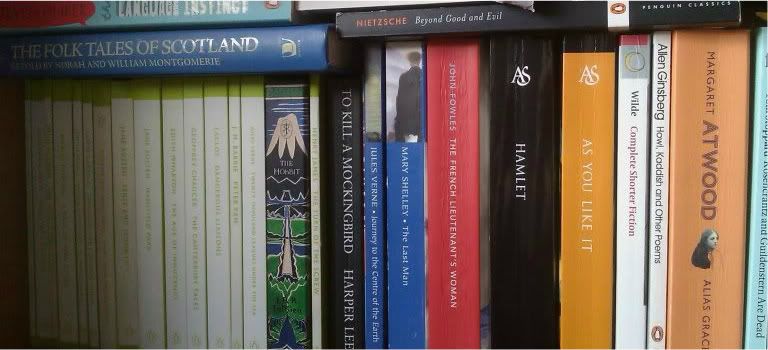
But I like to label my 'books' into different types. I know, it's pedantic but as an English literature student it's the only way to make any sense of my bursting book shelves ;)
Favourite feminist text:Alias Grace by Margaret Atwood. Or Nights at the Circus by Angela Carter. Both I studied in class and both are Neo-Victorian. I may even have to classift The Wide Sargasso Sea by Jean Rhys in this category. The latter is a prequel to Jane Eyre, and ultimately so much better.
Favourite drama: Angels in America by Tony Kushner. Hands down the best play to read, ever. Sub heading is a Gay Fantasia on Nationalist Themes, it's about labels in America, HIV/AIDS induced hallucinations. If reading a play isn't your thing, watch the HBO TV mini-series. Meryl Streep and Al Pac(h)ino are in it.
Favourite book of poetry: W.H. Auden: Selected Poems. I love Auden. His war poetry is so harrowingly hopeful, then so harrowingly desolate that it sends tingles up your spine. I could read his stuff over and over again. I bet many of you are surprised, considering my favourite poet is TS Eliot and my favourite poem is The Waste Land but alas. My favourite book of poetry is Auden ;)
Favourite Gothic book: Dracula by Bram Stoker, I believe. Although it is difficult to choose, again because there is so many to choose from. I love the story, I love the way it's presented and I love what it means. I could lie and say Frankenstein but... Alas. I hated Frankenstein when I did and it's only been recently that I've enjoyed it again.
Favourite book of criticism: the book that helped me the most throughout my career at university. There's two, actually. The Norton Anthology of Theory and Criticism, and Ways of Reading by Montgomery someone or other. The Norton book has parchment thin pages which make the most exquisite sound when you turn the page (I need the updated version). The Montgomery book is just brilliant. A text book but not a text book and it saw me through many essays. I have nostalgic love for that book.
Other notables: The Paris Wife by Paula McLain; Rosencrantz and Guildenstern Are Dead by Tom Stoppard; Rebus Series by Ian Rankin; Weight by Jeanette Winterson and On Chesil Beach by Ian McEwan.
What are your favourites?
Thursday, 7 March 2013

Wednesday, 4 January 2012
Everything I've read since september
It's a good thing I keep an old-fashioned reading journal. I'm going to do a quick post of all that I've read since my last post. Don't worry, there's not actually been that much.
The Passion of New Eve by Angela Carter - **1/2
I liked it but it was incredibly weird. A little too weird, perhaps and very disturbing. It's not a book that everyone would enjoy.
The Return of the Soldier by Rebecca West **1/2
The writing style was a bit disjointed which rendered what was essentially a decent story a tad confusing. I have to say, though, that the plot line (a soldier forgetting his wife and only remembering his old lover) is very fan fiction. And bad fanfiction at that.
"What we desire is greatness such as this, which had given sleep to the beloved."
The Honorable Schoolboy by John Le Carre
I didn't finish this book. It took me a long time to read Tinker Tailor Soldier Spy and this was on the same wavelength. What I found most difficult, though, was getting the movie characterisation of Peter Guillam out of my head.
Perfume by Patrick Suskind **1/2
This book has a reputation of being shokcing and disgusting so I had quite high expectations of it, which, sadly, weren't met. It's a good book, don't get me wrong but I could help but feel disappointed with the lack of freakiness about it.
The Woman in White by Wilkie Collins ***
In my ignorance, I thought this was a ghost story. Imagine my confusion and surprise when I found out that... it's not quite what I thought it was. I sitll enjoyed it, though, even though I did get muscly arms from holding it up for so long.
Oranges Are Not the Only Fruit by Jeanette Winterson ***1/2
I have to be honest, I don't even remember reading this book. I'm going by what it says in my old school jounral so I don't know if it actually deserves the three and a half stars it got - how good could it have been if I can't remember it? Anyway, according to my notes I enjoyed the interweaving of fairytale and standard narrative, and I wondered if it was at least in part semi-autobiographical?
The Deep Blue Sea by Terrence Rattigan ***
This play is really good. My notes say it is "another epic angst-fest about unrequited love". I remember this one, though, and it is really good. I went through phases with the main character - sometimes I pitied her, sometimes I empathised with her. And I liked the supporting cast.
"To love with one's eyes open sometimes makes life very difficult."
Good Morning, Midnight by Jean Rhys *
I didn't enjoy this book, which is surprising as it has all the elements that I love. But there was just something about the main character that grated on my nerves. I usually like stream of consciousness but this one was weird - it jumped between languages and showed her as a neurotic crazy person who I just could not sympathise with.
Good Omens by Terry Pratchett and Neil Gaiman ****
Third time I've read that book and I still love it. Crowley is excellent, Aziraphale is so genteel. I love all the footnotes and the tongue in cheek commentary on contemporary life. All of it, excellent.
"Many people, meeting Aziraphale for the first time, formed three impressions: that he was English, that he was intelligent, and that he was gayer than a tree full of monkeys on nitrous oxide."
As I Lay Dying by William Faulkner **1/2
A good book. I really enjoyed all the different voices but it was quite difficult to keep track of who was who.
--
Currently reading A Room With a View by EM Forster
The Passion of New Eve by Angela Carter - **1/2
I liked it but it was incredibly weird. A little too weird, perhaps and very disturbing. It's not a book that everyone would enjoy.
The Return of the Soldier by Rebecca West **1/2
The writing style was a bit disjointed which rendered what was essentially a decent story a tad confusing. I have to say, though, that the plot line (a soldier forgetting his wife and only remembering his old lover) is very fan fiction. And bad fanfiction at that.
"What we desire is greatness such as this, which had given sleep to the beloved."
The Honorable Schoolboy by John Le Carre
I didn't finish this book. It took me a long time to read Tinker Tailor Soldier Spy and this was on the same wavelength. What I found most difficult, though, was getting the movie characterisation of Peter Guillam out of my head.
Perfume by Patrick Suskind **1/2
This book has a reputation of being shokcing and disgusting so I had quite high expectations of it, which, sadly, weren't met. It's a good book, don't get me wrong but I could help but feel disappointed with the lack of freakiness about it.
The Woman in White by Wilkie Collins ***
In my ignorance, I thought this was a ghost story. Imagine my confusion and surprise when I found out that... it's not quite what I thought it was. I sitll enjoyed it, though, even though I did get muscly arms from holding it up for so long.
Oranges Are Not the Only Fruit by Jeanette Winterson ***1/2
I have to be honest, I don't even remember reading this book. I'm going by what it says in my old school jounral so I don't know if it actually deserves the three and a half stars it got - how good could it have been if I can't remember it? Anyway, according to my notes I enjoyed the interweaving of fairytale and standard narrative, and I wondered if it was at least in part semi-autobiographical?
The Deep Blue Sea by Terrence Rattigan ***
This play is really good. My notes say it is "another epic angst-fest about unrequited love". I remember this one, though, and it is really good. I went through phases with the main character - sometimes I pitied her, sometimes I empathised with her. And I liked the supporting cast.
"To love with one's eyes open sometimes makes life very difficult."
Good Morning, Midnight by Jean Rhys *
I didn't enjoy this book, which is surprising as it has all the elements that I love. But there was just something about the main character that grated on my nerves. I usually like stream of consciousness but this one was weird - it jumped between languages and showed her as a neurotic crazy person who I just could not sympathise with.
Good Omens by Terry Pratchett and Neil Gaiman ****
Third time I've read that book and I still love it. Crowley is excellent, Aziraphale is so genteel. I love all the footnotes and the tongue in cheek commentary on contemporary life. All of it, excellent.
"Many people, meeting Aziraphale for the first time, formed three impressions: that he was English, that he was intelligent, and that he was gayer than a tree full of monkeys on nitrous oxide."
As I Lay Dying by William Faulkner **1/2
A good book. I really enjoyed all the different voices but it was quite difficult to keep track of who was who.
--
Currently reading A Room With a View by EM Forster
Monday, 12 September 2011
Anansi Boys, Neil Gaiman
I should also state that I finished Anansi Boys by Neil Gaiman.
I think once you've read one Neil Gaiman book you've read them all.
That's not to say I didn't enjoy it because I did but there's just something... Repetitive in his style and story-telling. Particularly with his characters; I just couldn't get emotionally invested in any of them.
But still, it's a book worth a read. **
One Day, David Nicholls
I read One Day by David Nicholls last week before I moved.
I actually quite enjoyed it. When it had first come out I had (in my high-brow fashion) shunned the book as best-seller rot but having read it, I will revise my statement. It’s not exactly what you would call literary history stuff but it is pretty decent. The concept alone is enough to garner my praise.
We meet Emma and Dexter on July 15th, 1988 after their graduation from Edinburgh University. The book is their life on July 15th for the next twenty years. You don’t see anything that happens before or after it and you’re left wondering what you missed but it all adds to the mystery of the novel, the feeling of trying to piece together where their lives have been and where they are going.
The characters are likeable, if a little stereotypical. Dexter is the rich boy who gets everything handed to him and goes off the rails for a bit. Emma is from a working class family, feminist, pacifist whose life is not exactly what she wanted it to be until, eventually, she swallows her pride and asks for a favour and everything ends up brilliant (she gets her book published and spends a lovely summer in Paris (for which she learned to speak French. Yeah.)). But all through it you just want to bash their heads together (particularly Dexter’s) and make them see what is right in front of them. But I guess that’s the beauty of the story; they had to go through all that they went through for them to be able to be together. If they’d gotten together at uni… Yeah. Dexter wasn’t ready for that and Emma’s view of him was too wide-eyed and rose-tinted.
The only thing I didn’t like about was the ending. I mean… I actually loved the ending (eee, the angst!) but I didn’t like the way it was written. It just sort of… happens. I guess it’s to show the suddenness with which life can change but still… It’s. Emotionless. And in the next chapter Dexter is back to his old ways and while we know why it makes him look like a complete arsehole.
Regardless, I would still recommend it. I would recommend the movie, too, if it wasn’t for Anne Hathaway’s accent. If her accent was the same and bad all the way through, fair enough. But it changes to a plethora of different accents throughout which makes it difficult to ignore.
A good read. ***
--
Now reading The Passion of New Eve
Wednesday, 17 August 2011
Anansi Boys, Neil Gaiman
Reading Anansi Boys by Neil Gaiman. It's all right. Nothing spectacular. Everytime I pick it up I've to fight with myself not to fall asleep. (That's not a reflection on the book, but more of a reflection on the sorry state of my sleeping/working habits).
What I really want to read read is Deep Blue Sea by Rattigan. I will finish Anansi Boys first, though, I think.
Monday, 15 August 2011
After the Dance, Terence Rattigan
I read After the Dance on the train on the way down to Sheffield last Sunday. I bought it after watching The Rattigan Enigma on the BBC and I had high hopes for it. I wasn't disappointed.
Written in 1939, After the Dance appeals to my pre-/leading-up-to-the War sensibilities and deals with many of the issues prevalent in the latter half of my favourite decade. It showcases Joan and David's lives as they try to maintain the image of The Bright Young Things but the impending war and falseness of their chosen escapism begins to show itself when the beuatiful young Helen sweeps in and changes their lives with her modern, realist (to some extent) views on what they (the Bright Young Things) are trying to do.
The inevitability that is present in many of the late 30s literature is still there in the background; Julia's young friend is conscripted, for example. There isn't much reference to the War but I guess that's the point – they were trying to ignore that it was about to happen. So they keep having their parties and drinking their drinks and telling their jokes and ignoring the life-changing event that lingers at the back of their consciousness.
Not only is this a story of escapism, it's also a story about love and communication. Joan loves her husband but never tells him - instead, she chooses to change her personality during the course of their marriage so that he is what she thinks he wants. I do think that David loves Joan, even though he says otherwise. He reacted rather badly after Joan's death – he refused to let others talk about it in his presence. I don't believe that he loved Helen – given the rest of the play's lack of communication when it comes to love, the fact that he tells Helen he loves her says to me that he doesn't. If he did, he would never have told her. I do think he is infatuated with her; she appeals to his ego and is willing to give up a promising future to be with him. But when it comes down to it, he leaves her – in a way that he never left Joan.
I think it's tellingly important that the play didn't end with Joan's death. Rattigan allows us to see the aftermath, the way that people move on (and the way that some don't). John is forced to grow up after Joan's death - the way that others of the Bright Young Things were forced to grow up during and after the war. David has to reassess his attitude to life and love and his place out of the spotlight once his dance in it is finished.
The play is haunted by one, huge question that, regardless of class, situation sexuality etc. is very poignant.
“Why didn't you say anything?”
I think this question refers to more than simply talking about love, but to the wider contextual situation regarding appeasement and the rise of the Nazis in Germany showing that After the Dance is both a play about love and a play about War.
My two favourite themes.
--
see also Autumn Journal, by Louis Macneice
Friday, 5 August 2011
Hedda Gabler, Ibsen
Just finished reading Hedda Gabler. Despite it reminding me of the worst class ever put on by any uni anywhere ('The Superfluous Man of 19th Century Literature' ugh) I actually really enjoyed it. It's a short play so was relatively quick to read and, despite it being written in 1890 there is still something indescribably modern about it.
Hedda is bored with married life; she has married a man she does not love and whom she has very little in common (he also has no money and she's forced to spend six months on a 'honeymoon tour' with him, during which he reads books and does research for his book). You can't help but feel a little sorry for her, even though she's a bit of an evil cow, to be honest.
It's understandable - 19th century marriages couldn't be much more than dull. Ad marriage into a poorer family than the one you come from would be even worse. Even while she was lying and poking her nose about here and there, I still admired her. Ibsen has written her as an unlikable character (I believe) who we can't help but sympathise with.
I appreciate the fact that the text is called 'Hedda Gabler' rather than 'Hedda Tesman'. As Ibsen himself stated, he called her by her maiden name to show that she was “her father's daughter, not her husband's wife”. It's very, very feminist. I believe the use of female names is important in Victorian-era literature – Jane Eyre's name should have been 'Jane Rochester' but it's not – it shows that the character of Jane is more than the sum of her marriage to Rochester. Similarly, many characters in Hedda Gabler (Brack and Eilart, for example) can't bring themselves to call her Hedda Tesman. In fact, when Lovborg refers to her as Hedda Gabler (softly, and more than once) she simply stares at him then reminds him that her name is Hedda Tessman.
Her name may have changed. But she's still Hedda Gabler to them.
I also loved Hedda's reaction to Lovborg killing himself – her response is to call it a “beautiful act” - she had even encouraged him to do it by giving him one of her pistols. What amused me, perhaps to most, was the image of Hedda aiming her gun at Lovborg. When she shoots at Brack from the window, the image is of an empowered woman, trapped in a cage. This image is also intensified by the fact that the whole play is acted out in the same stage set up – we never see Hedda anywhere but in those two rooms. She is well and truly trapped, and going crazy for it. I enjoy this aspect of Ibsen's writing (I read Doll's House and articles on the same for my dissertation on gender roles in Victorian literature) and find it comforting (and annoying) that outwith the sphere of Empire, the view of women was not quite so constricted as to have them happy in marriage and the home. Hedda isn't happy to be married, nor to be at home and I imagine that the image of her as trapped in the home ruffled a few Victorian feathers.
I enjoyed Hedda Gabler. It was funny, thoughtful and, despite reminding me of That Class, I would definitely recommend it.
I will leave you with a few of Ibsen's comments on Hedda Gabler
‘Hedda really wants to live the whole life of a man’.
(notes) (1)
I must disclaim the honour of having consciously worked for women’s rights. I am not even quite sure what women’s rights really are. To me it has been a question of human rights...Of course it is incidentally desirable to solve the problem of women; but that has not been my whole object. My task has been the portrayal of human beings.
(speech to the Norwegian Society for Women’s Rights 1898) (2)
(1), (2) from the Almeida Theatre's program of Hedda Gabler, directed by Richard Eyre. 2005.
Subscribe to:
Comments (Atom)