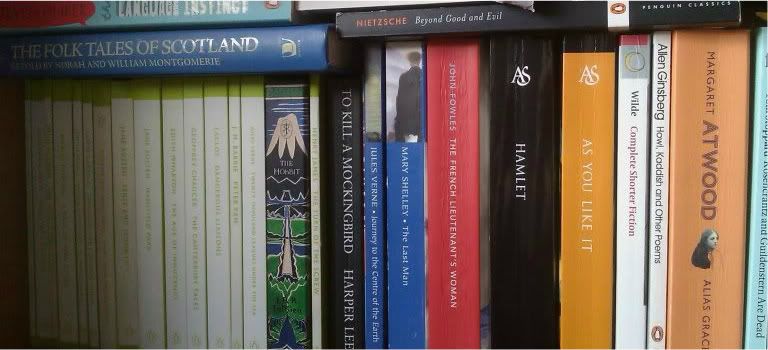
So I persevered with The Blind Assassin and finished it in a few hours. I'm glad I did. I rather enjoyed it. It was a little predictable, as by part three or four I had figured out what ended up being the 'big reveal'. I even tweeted about it (the photo intrigued me). Also, I think the way that it was revealed indicated, in my opinion, that Atwood knew the reader would have it figured out by then. Either that, or it was supposed to be delivered quite blandly (or perhaps I read it that way since I'd figured it out anyway and thus it didn't come as quite as much of a shock? Regardless...)
Things I noted about old Iris' writing style that indicated to me the true author of the story The Blind Assassin: she would become suddenly very lyrical. Most of the 'present-day' narrative is like reading an old woman's diary (which is exactly what it is, essentially) and then suddenly she comes out with lines like
“he throws out radiance, it must be reflected sun”
“Does naming a sphere of nothingness transmute it into being?”
These are lines that are very similar to the style of writing in “Laura’s” story. Also, as we get to know Laura, we realise that she couldn’t possible have written The Blind Assassin; she is too literal to fully grasp the metaphor. That Iris is even writing her diary as a memoir of her own life (reasserting herself, reasserting her true past) indicates from the get-go that she was the one who wrote The Blind Assassin.
The “Laura” storyline wasn’t as shocking as I think it was supposed to be; again, I figured it out (from when Laura moved to Toronto and left the room whenever Richard came in, to the way she would use all of Iris’ things…)
I like none of the two women in this story. I don’t like any of the Iris’ (and I say any because I don’t believe we see just ‘one’ – there are many, many version of Iris in this: the not-so-naïve child; the passive wife; the clingy lover; the lover; the bad sister; the batty old woman… the list goes on) and there’s something about Laura that I just can’t get my head around. The females are all stereotypes. Reenie and Myra are typical ‘house-workers’: they are religious, gossipy, lower class women who simultaneously revere and abhor the people that they work for. Winifred is the evil nouveau riche who hides her catty character behind a façade of charity and ‘friendliness’. Iris is just as much a stereotype as the rest of them: she goes from being the passive daughter to the lady of leisure who takes a lover because she is bored of her husband, then becomes clingy with her lover (I believe at one point she asks him if he is faithful to her (at which point I cringed for her, I really did)). I do believe that Iris is a victim but I’m not entirely sure that she’s not her own worst enemy. If only she’d found her backbone a little sooner…
Out of them all, though, I like Laura the most. While she may be a little ‘tuned to the moon’, she is also the most easily understood (in my eyes). She sees the world so simply in black and white, so flat and one dimensional. In a way, she’s just as colourless as Iris, despite her apparently ‘whacky’ character.
What I did like, though, was the feeling that we only got to know these things because Iris was scared of dying. It’s not a nice thing to like, I guess, but I did. If Iris hadn’t found out about her ‘heart problems’ would she have felt the need to tell Sabrina, Myra and whoever they chose to tell the truth behind The Blind Assassin? Probably not. There’s also the feeling that Myra, or Sabrina has gone through Iris’ chest and is showing us these things that she has collected (the transcript of The Blind Assassin, the newspaper clippings, etc) and that we are slowly re-realising Iris’ true self. It really drives home the feeling that life is made up of fragments, of moments remembered while others are forgotten along the way. We cannot remember every single thing that happens to us (our hard drives are simply too small to have a memory like that) and so fragments are all that remains of a life (fragments of memory, as well as fragments of stories and newspaper clippings).
I also enjoyed the significance of Richard being ‘found dead’ (I took this to mean that he killed himself…) after receiving a copy of The Blind Assassin. Iris loses her past to her sister but by using the pen (a phallic instrument of power) she gains control over the man who tries to control her. Again, she uses a pen (a sticky-inked biro) to reassert her true identity, to reclaim her past when she writes her diary in her old-age.
I don’t really know what to say about this book. It was good (just not in the middle, it gets a bit tedious but the need to know what is going on for sure keeps you reading) but I can’t really comment on why it was good. I mean, I’ve just stated that I liked none of the female characters (Myra, perhaps, comes to closest to a ‘favourite’ character but really…) I welcome comments that explain why this book was as enjoyable as it was, considering I had such a difficult time getting through it. Is it the lyricism? Or is it merely the enjoyment of piecing the puzzle of the narratives together?
I don’t know.
I guess that’s a sign of how good it is?

No comments:
Post a Comment